
Sheba’s legs
A series of incantation bowls honouring the divine feminine
‘Sheba’s Legs’ takes inspiration from the ancient Mesopotamia practice of the incantation bowl and the notion of ritual as a process of healing and re-memorising.
Commonly known as ‘magic bowls’ and used across the Abrahamic religions to expel demons and protect houses, such bowls were inscribed with incantations, divine names, curses and spells (and often with a femail figure inscribed in the centre of the bowl). This sacred text, it was believed, would trap demons inside the bowls, which were often turned upside down and buried.
In this series of ephemera, gilded disposable paper bowls woven with foraged neighbourhood grasses and seeds and Japanese silk thread are inscribed with biblical verses. The bowls, by design, represent sustenance; their material riches of and from the earth. But the ‘sacred text’, which was cut from a recently inherited family bible, rather than promising protection or absolution, reflects a devaluing of the divine feminine – be it woman and/or nature – and an affirmation to vulnerability, submission and slavery.
In this way, the bowls could be viewed as a kind of lamentation. It is not a demon that is trapped, shaped and discarded by sacred verse, but the ‘female’ Other.

Why Sheba’s legs?
The fable of the Queen of Sheba and King Solomon is famed across the three Abrahamic religions. While each covets its own version of this mysterious queen from a wild, foreign and distant land, all speak to the same narrative: a woman, an outsider, independent and a ruler in her own right, who ultimately bows down - politically, intellectually, and sexually - to the all powerful King Solomon, a king, these religions would have you believe, who was richer and wiser than any other king in the world and who had been granted his wisdom directly from God. But it is in earlier Hebrew texts we find cause
In the Targum Sheni (8th century C.E), an expansive Aramaic translation of the book of Esther, we find an addition to the Queen of Sheba/Solomon story intent on denigrating the queen where, in arriving at Solomon’s palace, she mistakes the glass floor for water and lifts her skirts to reveal her legs:
“She lifted her garments as if to cross over (the floor she assumed was water) and he (Solomon) saw that she had hair on her legs/feet.”
Solomon comments:
“Your beauty is the beauty of women, but your hair is the hair of men, and hair on men is beautiful, but on women it is shameful.”
The Alphabet of Ben Sira (9th/10th century C.E.) then builds on Solomon’s problem with the queen’s body hair. It begins with the claim that Nebuchadnezzar, the king of Babylonia who destroyed the First Jerusalem Temple in 586/7 B.C.E., was born to Solomon and the Queen of Sheba. Ben Sira tells Nebuchadnezzar the story of his parents’ meeting, comedically asserting that Solomon’s response to the hairiness of the queen was to invent a hair-removal cream:
“He wanted to have sex with her, and discovered she was exceedingly hairy. At that time there was not among the daughters of Israel hair under their clothing, [so] Solomon began and said to his servants, bring to me a lime (and arsenic) and take the lime and sift the lime in a sieve and grind (the arsenic) and mix it together; and they did thus, she looked at it, and they cleansed all her flesh and wiped off the hair and thus he did to her according to his will.”
Only after removing her hair does Solomon sleep with her, making explicit the vulgarity implied by Targum Sheni.
Naming the series thus both mirrors the belittling passages cut from the bible and used in the bowls and honours the power and wisdom, the wildness and otherness, of a queen some say was both djinn and human and thus existed outside the patriarchal order of gender relations.
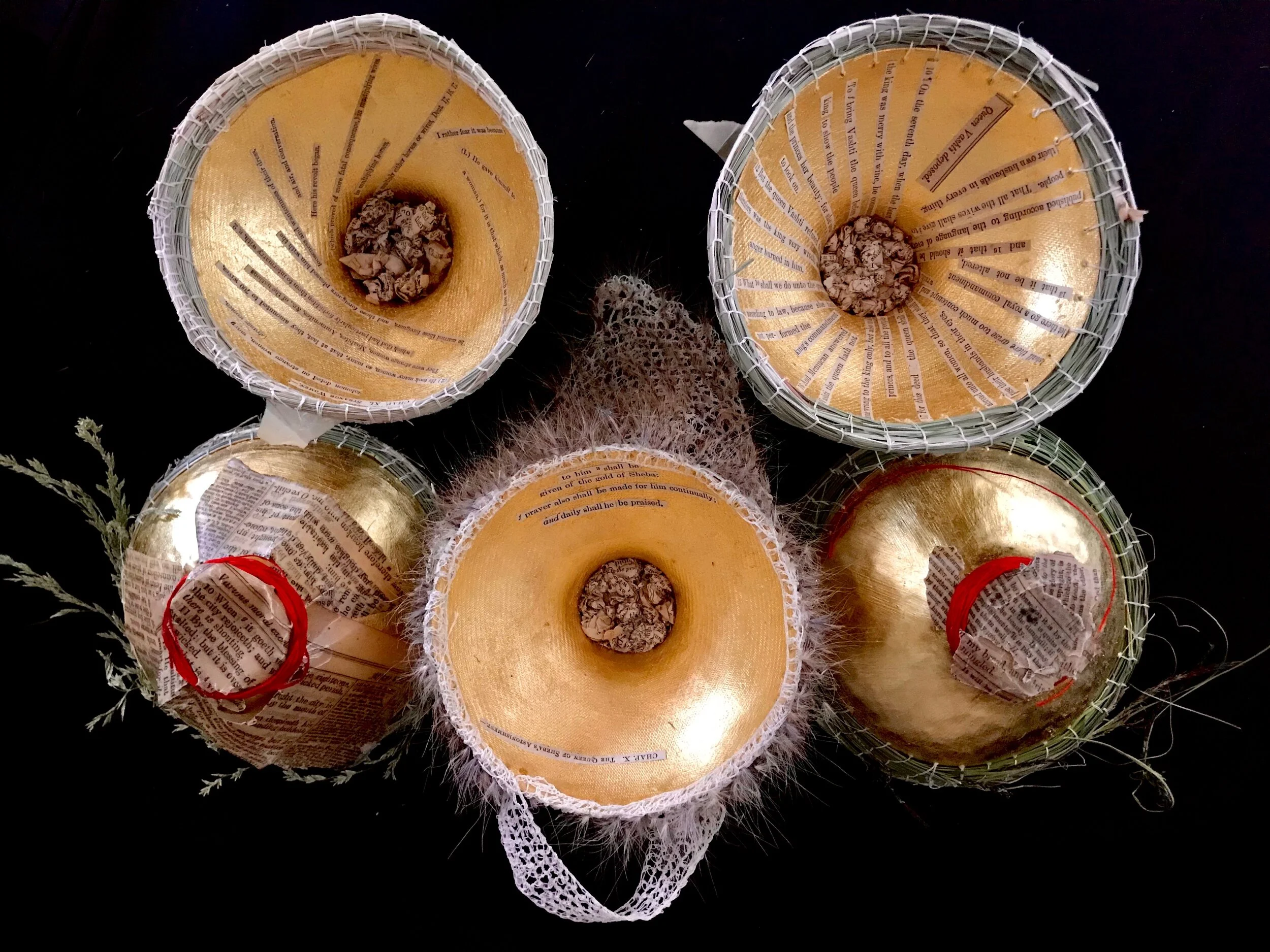
‘Sheba’s legs’ - disposable paper bowls, 23k gold leaf, neighbourhood grasses and seeds, Japanese silk threads, beeswax, pages from antique bible.